

Launching a new eyewear collection is not simply about finding beautiful frames. For brands, distributors, retailers, and emerging eyewear businesses, the real challenge is building a collection that customers want to buy, that can be produced efficiently, and that creates healthy margins.
A strong eyewear collection needs the right balance between design, materials, price positioning, production volume, and market demand.
This is where working with an experienced eyewear manufacturer can make a significant difference.
1. Start With a Collection Strategy, Not Individual Products
One of the most common mistakes new eyewear brands make is selecting products one by one without considering the collection as a whole.
A successful collection should have a clear structure.
For example, a brand might divide its collection into:
- Core best-selling styles
- Fashion-forward seasonal designs
- Premium statement pieces
- Entry-level products
- Specialty products such as polarized or sports eyewear
This approach allows different products to serve different customer needs while maintaining a consistent brand identity.
Instead of asking, “Which frame looks good?”, professional buyers should ask, “What role will this frame play in my collection?”
That change in thinking can have a major impact on inventory management and sales performance.
2. Choose Materials Based on Your Market Position
Material selection is another important part of eyewear product strategy.
Acetate, TR90, injection-molded materials, metal, and other materials each offer different advantages in terms of appearance, weight, durability, production cost, and design flexibility.
For premium and fashion-oriented collections, acetate can provide distinctive colors, layered patterns, a high-quality surface finish, and excellent adjustability. FANSI Optical, for example, produces handmade acetate frames using CNC cutting, tumbling, and hand polishing techniques.
For lightweight, flexible, or high-volume products, materials such as TR90 or injection-molded plastics can offer different commercial advantages.
The key is not to ask which material is “best.”
The better question is:
Which material is best for this product, this customer, and this price point?
A professional eyewear supplier should be able to help you make that decision.
3. Build a Product Portfolio That Controls Risk
For many eyewear businesses, inventory is one of the biggest financial risks.
Ordering too many styles can leave a brand with slow-moving stock. Ordering too few styles can make the collection look repetitive and limit customer choice.
A smarter strategy is to create a balanced product portfolio.
For example, a collection could contain a larger number of proven commercial shapes, supported by a smaller number of experimental or fashion-driven designs.
This creates a balance between commercial stability and product innovation.
An experienced OEM eyewear manufacturer can also help brands identify which designs are more suitable for standard production and which products may require additional development or tooling.
4. MOQ Should Be Part of Your Product Strategy
Minimum Order Quantity, or MOQ, is often treated simply as a purchasing issue.
In reality, MOQ should be considered when designing the entire collection.
If every style requires a large investment, launching a new collection becomes expensive and risky.
Flexible production options can be particularly valuable for emerging brands and boutique retailers. For example, handmade acetate production can provide greater flexibility for certain smaller-volume projects compared with high-volume injection production, where tooling and unit economics often favor larger orders.
The right OEM glasses supplier should therefore help you find a production model that matches your sales expectations rather than simply pushing you toward the largest possible order.
5. Design for Manufacturing, Not Just for Appearance
A frame may look excellent in a sketch but become difficult or expensive to manufacture.
This is why professional product development matters.
During the development process, experienced eyewear engineers and designers consider factors such as:
- Frame dimensions
- Hinge construction
- Material thickness
- Weight distribution
- Lens shape
- Assembly requirements
- Surface finishing
- Production tolerances
Good eyewear design is not only visually attractive. It also needs to be commercially manufacturable.
At FANSI Optical, the development process combines product design, prototype development, sampling, and quality inspection to help transform concepts into production-ready eyewear.
6. Think About the End Customer From the Beginning
The best eyewear collections are designed around the customer rather than the factory.
Consider who will actually wear the product.
Is your target customer looking for lightweight everyday eyewear? Premium acetate? Fashion sunglasses? Functional sports eyewear? Affordable optical frames?
The answer determines everything from materials and colors to frame shapes and pricing.
For example, FANSI Optical’s product range includes acetate sunglasses, metal sunglasses, optical frames, and other eyewear categories, allowing different product concepts to be developed according to market requirements.
7. Your Manufacturer Should Think Like a Business Partner
A good eyewear supplier delivers products.
A great manufacturing partner helps you make better product decisions.
The difference can be seen in communication, sampling, material recommendations, quality control, production planning, and problem solving.
When developing a new collection, the ideal process should look something like this:
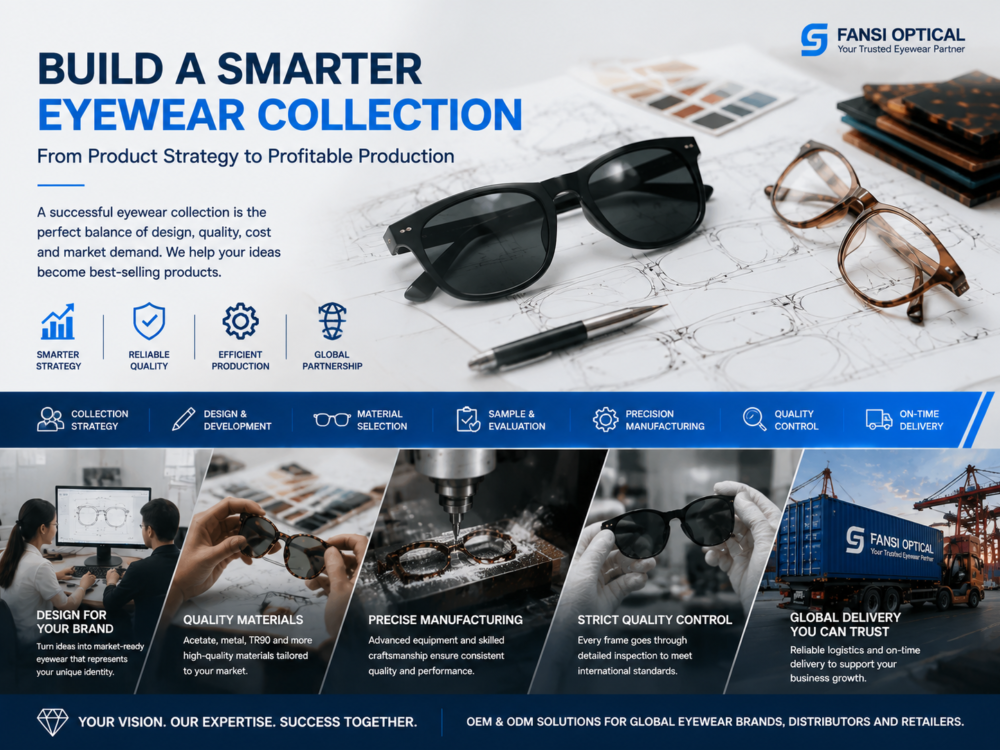
Market Research → Collection Strategy → Design → Material Selection → Prototype → Sample Evaluation → Production → Quality Control → Delivery
Every step influences the final commercial result.
That is why choosing an experienced eyewear manufacturer and OEM/ODM partner should be viewed as a strategic business decision rather than simply a price comparison.
Build a Collection That Is Designed to Sell
The future of eyewear manufacturing is not simply about producing more products.
It is about producing the right products.
For brands and buyers, a smarter collection means combining attractive design with practical manufacturing, appropriate materials, controlled inventory, competitive pricing, and reliable production.
At Fansi Optical, we work with eyewear businesses to turn ideas into commercially viable products—from material selection and product development to manufacturing and quality control.
Whether you are building your first private label eyewear collection or expanding an established product portfolio, the right manufacturing partner can help reduce development risks and create better opportunities for growth.
Your next successful eyewear collection should not start with more products. It should start with a smarter strategy.